Reading a Pooja Room Wall: What the Cows, Lotus and Peacock Are Actually Telling You
The mandir wall is the only wall in most homes that gets properly looked at. Every other surface is passed by. This one is faced, usually while sitting, often in the light of a single lamp, sometimes for several minutes at a stretch. That changes what belongs on it.
Traditional motifs were built for exactly these conditions. Cows, lotuses, peacocks and bells were not chosen because they filled space nicely. Each does a specific job, and once you know what that job is, choosing a wall for your worship corner stops being guesswork.
The cow sets the mood of the wall
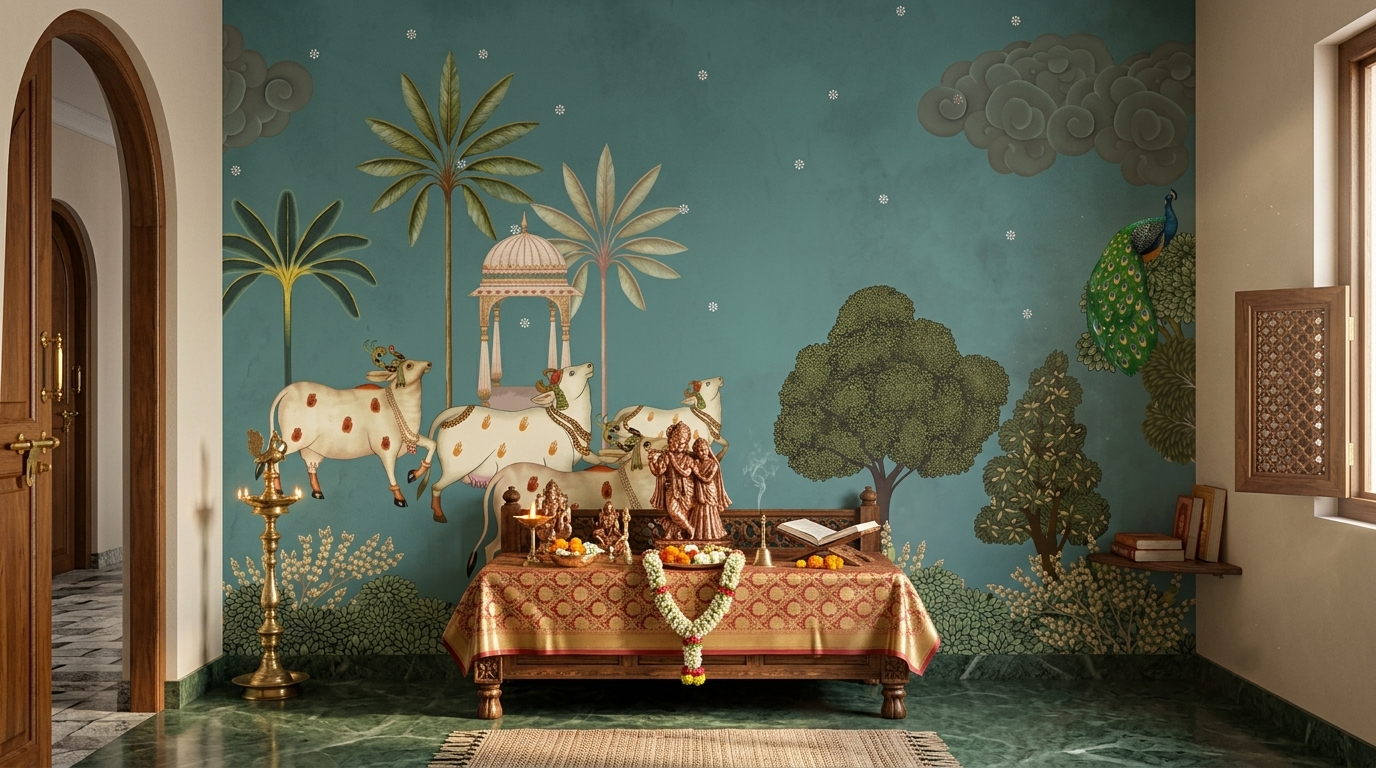
Cows arrived on these walls through Krishna the cowherd, and through Gopashtami, the day the herd is honoured. In a painting they almost never look busy. They stand, they rest, they turn their heads slowly.
That stillness is the point. A herd at rest slows the whole composition down, which is what you want in a pooja room meant for sitting quietly. It also means cows are forgiving neighbours for a crowded shelf. If your mandir already holds idols, photographs, bells and a lamp, a resting herd behind it will not fight for attention. Pieces such as Neel Pichwai from the pichwai wallpaper range work this way, with the herd holding a steady base while the deeper indigo carries the upper half.
The lotus tells you where to look
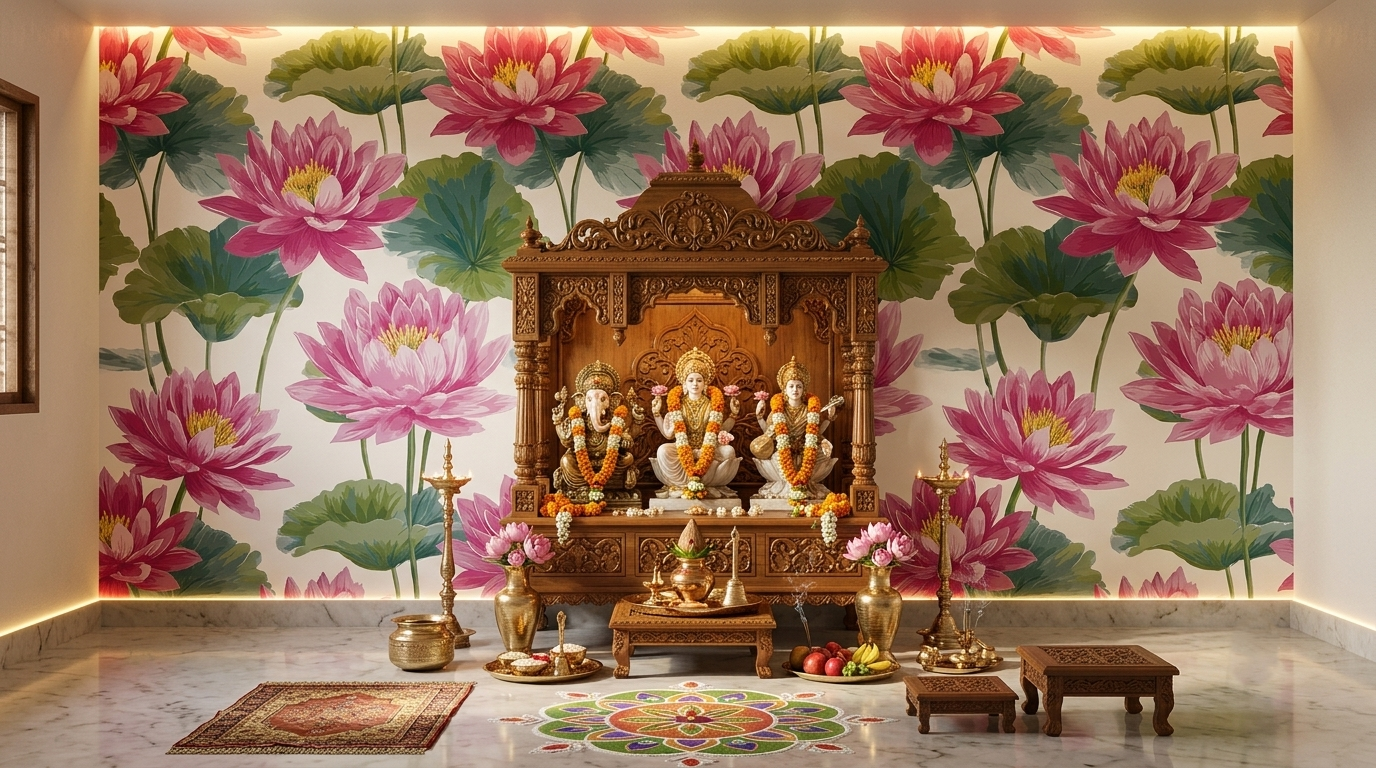
If the cows set the mood, the lotus sets the focus. It is the seat of the divine in almost every telling, which is why painters place open blooms where they want the eye to settle.
Use that. Hold your chosen piece against the wall and find the largest open bloom. In a worship corner, that bloom should land roughly at the height of your gaze when you are sitting down, which for most people is somewhere between three and three and a half feet. Too low and it disappears behind the mandir unit. Too high and you are looking up at a flower rather than at your idol. A bloom-led piece such as Lotus Bloom Symphony makes this easy to judge, because the flowers repeat at a predictable rhythm rather than sitting in one fixed spot. The wider lotus wallpaper range gives you both options, fixed scene and repeating bloom.
The peacock marks the season and holds the edges
Peacocks signal the monsoon, and carry the feather from Krishna's crown. Painters almost always use them in pairs, one at each outer edge.For your wall, treat that pair as the frame. If you narrow the piece to fit a small corner and the birds get trimmed away, the middle of the composition loses its stops and starts to drift. Measure the usable width first, then choose. A tall, narrow worship nook is better served by a piece where the birds sit inward, or by one that leaves them out altogether.
Bells, kalash and the top border
Look at the upper edge of a traditional worship scene and you will usually find a row of bells, a kalash, or a garland of mango leaves. These are threshold markers. In a temple they announce that you are crossing into the sanctum.They only work if you can see them. This is the commonest mistake in a home mandir: the top border sits at ceiling height where nobody looks, or gets swallowed by a false ceiling or a light cove. If the piece you like has a strong upper band, plan for it to sit within the top third of your eye line, not above it.
What the wall does under lamp light
Most worship happens in the early morning or after sunset, under a diya or a warm bulb rather than daylight. Deep indigo, black and heavy maroon lose almost all their detail in that light, so an intricate scene in those tones can flatten into a dark rectangle by evening.Ivory, pale gold, soft green and saffron behave far better. If you have set your heart on a darker piece, place a second light source to the side rather than relying on the lamp alone. Test this before you commit, ideally by holding a sample against the wall at the hour you actually pray.
Sometimes the wall should say very little
Not every worship corner needs a full narrative. A small niche already holding brass, cloth and idols can be overwhelmed by figures, and two sets of faces on one wall rarely sit well together.For these spaces, a quiet repeating backdrop does more. Shyam Kunj from the traditional wallpaper range is a good example: soft trees and foliage, no faces, nothing competing with what you place in front of it.
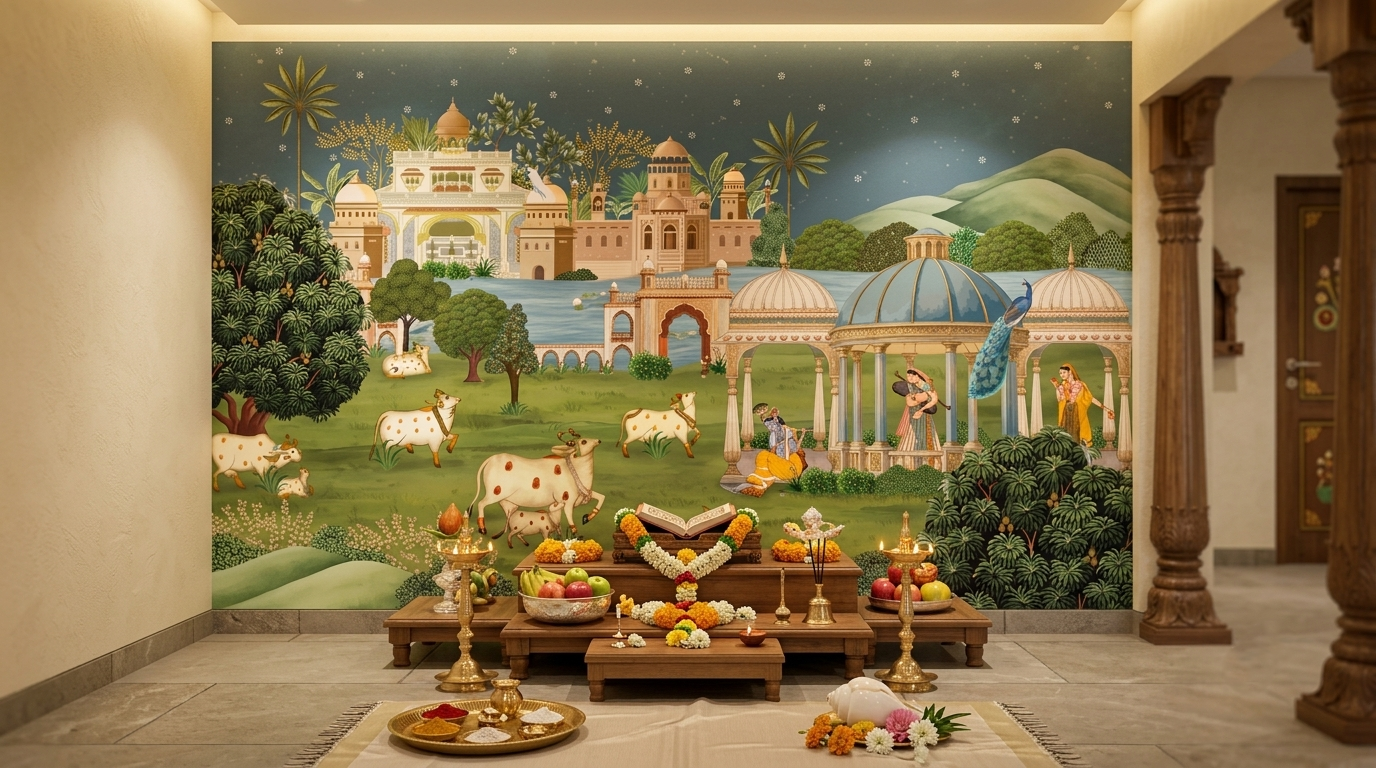
If you do want a devotional scene as the main subject, keep the shelf below it plain. A piece like Lord Radha Krishna from the spiritual wallpaper range is meant to be the focus, not the background.
Frequently asked questions
Which wall of the pooja room should carry the pattern?
The wall your idols face, which in most homes is the one behind the mandir unit. Vastu commonly points worship towards the north east, so if you have a choice of corners, that is the usual starting point. Keep the remaining three walls plain so the focal wall stays the focal wall.
Which colours hold up best in a worship corner?
Ivory, cream, pale gold, soft green and saffron. They reflect lamp light instead of absorbing it, which matters because most prayer happens in low light. Deep blue, black and heavy maroon can look flat by evening unless you add a second light source.
Should I choose a single scene or a repeating pattern?
A single scene suits a wide wall with an open centre. A repeating pattern suits a narrow niche, an odd shape, or a wall broken up by a shelf, because you can cut it anywhere without losing the composition. Small corners usually do better with a repeat.
Do the cows and peacocks need to be there?
No. They carry meaning, but a plain motif or a symbol led backdrop is equally valid, and often better when the shelf below is already busy. What matters is that the wall supports your idols rather than competing with them.
Before you order
Measure the wall, then measure whatever stands in front of it. Sit down and note where your eye lands. Check the palette at prayer time, not at noon. Then pick the composition whose centre agrees with your eye.Ready to plan yours? Browse the pooja room wallpaper range, or start from the full wallpaper catalogue and filter down to the palette your corner can carry.
